IMMANENT CORPOREALITY IN POST-TONAL MUSIC
Between Hearing, Seeing, and Touching
Mag. art. Michael Pinkas
mdw – University of Music
and Performing Arts Vienna
Introduction
Beyond the familiar experience of listening at a classical concert, a musical gesture can be followed visually by the audience and felt by the player through contact with the instrument. These modes of perception do not necessarily coincide. A movement inherent in playing may remain clearly visible even where its relation to what is heard has become uncertain. I use the term immanent corporeality to describe a compositional strategy for producing spatiotemporal presence in musical performance (cf. Matthias Rebstock’s “Strategien zur Produktion von Präsenz,” 2011). This strategy takes compositional form at the limits of sensory perception and may produce contradictory impressions among audience members. The corporeality of a gesture may thus be brought into focus even in concert performances of post-tonal music without explicit theatrical staging—a possibility I explore in my current compositional and analytical research.
In Lecture on Immanent Corporeality, a posthermeneutic concert-and-lecture project, I investigate these discrepancies as constellations of hearing, seeing, and touching through the composition and performance of post-tonal music. The project combines a practice-led preparatory phase, a forty-five-minute performance-lecture, and post-performance reflection by composers, performers, and listeners. Selected findings will be presented at SAR 2027 in Bratislava through this Research Catalogue exposition. The project is supported by the University of Music and Performing Arts Vienna (mdw) through its AR Pilot programme from October 2026 to June 2027.
The central research question is:
How can immanent corporeality in post-tonal music be investigated through the relations between hearing, seeing, and touching in composition, performance, and post-performance reflection?
2.The Visible Sound & The Audible Body
Robert Hatten (2004) examines the communicative aspect of musical gesture in the repertoire of Mozart, Beethoven, and Schubert. In music after 1945, Martin Zenck approaches musical perception through the relation between hearing and touching. For Zenck, “hearing takes place with all the senses, but above all through touch, with the skin, and also with what gets under the skin” (2014, 136). Stephanie Schroedter draws a related distinction between watching and Hinsehen(looking closely), which she pairs with Hinhören (attentive listening). Through a “visually probing retracing of the visible movements of playing,” the ear may be “sharpened, but also unsettled” (2017, 230).
In artistic research, Sigrun Heinzelmann and Sihua Ren (2023) investigate voice leading in Chopin’s Nouvelle Étude in A-flat major through the experience of playing with different fingerings. Guy Livingston (2025) examines the performance of musical silence through “audible, visual, and notational markers.” Barbara Lüneburg (2026, 474) examines performers’ visible movements through her practice-based method Re-enacting Embodiment, observing that “Gestures and music are closely, almost intimately fused.”
The intermedial relations of musical performance raise further questions. Stefan Drees (2011, 43) describes “media interactions, interferences, phenomena of crossing media boundaries, interrelations and interfaces between distinct media, as well as their differences.” Dieter Mersch’s posthermeneutic thinking directs attention to the in-between, a space he describes as “equally indeterminate and open” (2010, 205), where relations affect the production of meaning without themselves being reducible to signs. Such intermediality “produces its own interferences, countermovements, and ‘chiasms’” (Mersch 2010, 276).
A difficulty for the lecture format is expressed by Cosima Linke, who observes that “perhaps the lecture is not the right medium through which to grasp its object [the work of art]” (2025). In an earlier study of music education, I suggested that an insight reached through dialogue might remain unspoken and still be “recognisable to composers in their ‘compositions’ and to performers in their ‘interpretations’” (Pinkas 2022, 30). Lecture on Immanent Corporeality takes up this problem by examining the possibilities and limits of musical analysis within performance itself.
3.From musical analysis to composition
The question of immanent corporeality arose in the course of my doctoral research on the performative perception of form in Isabel Mundry’s music. I approach visible sound and the audible body as phenomenological figures of thought through which I trace the relation between tactility and orality across sequences of sound events. Following Mersch’s posthermeneutic thinking, these figures are understood not as fixed identities but as chiasmatic relations in which hearing, seeing, and touching intersect without necessarily coinciding.
At the opening of Mundry’s Noli me tangere (2019/20), a tambourine is fastened against the soloist’s abdomen. A sweep of the palm across its surface is broken into a succession of touches and continued in strokes on the tam-tam. At the close of the phrase, the soloist’s breath is amplified in the hollow of the cupped hands. What was first heard as the contact of hand and membrane can now be heard as breath given resonance by those same hands. The oral gesture thus acts both as a counterweight to the tactile gesture and as a point of connection with it. Their relation emerges through the succession and transformation of sound events.
In her note on Noli me tangere, Mundry describes the relationship between solo percussion and ensemble in terms of “forms of resonance, never of assimilation” (2020). Later in the work, some of the players turn away from the conductor and take their timing by ear. Of these passages Mundry writes, “Touching takes place in hearing” (2020).
The first thirteen bars, lasting thirty seconds in the echtzeitEnsemble recording, are represented in a Hörbild, a graphic representation of what was heard. The timing of audible events was checked against a spectrogram, while their dynamics were drawn as perceived in listening (Pinkas, in preparation). This analysis developed from my paper on hearing-biographical and autoethnographic methods, presented at the 2023 conference of the Gesellschaft für Musiktheorie in Freiburg. In my composition diary, I traced repeated hearings of Mundry’s work alongside my composition of the string quartet Virtues and Vices (2023), in which gestures take the form of discrete events bounded by silence as frozen gestures.
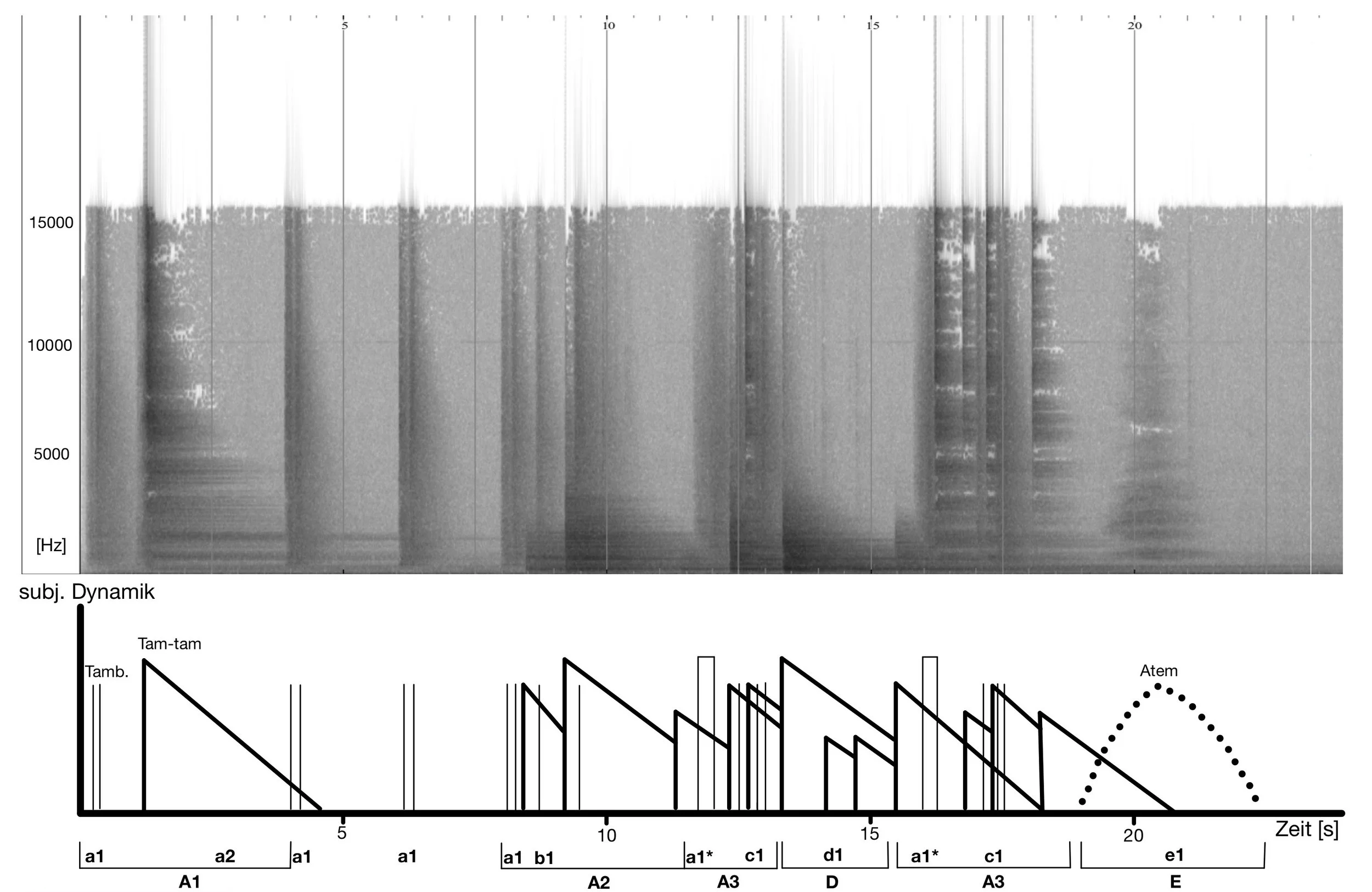
Audio 1. Isabel Mundry, Noli me tangere (2019/20), bars 1–13 (0:00–0:30). Recording by echtzeitEnsemble.
Figure 1. Isabel Mundry, Noli me tangere, bars 1–13. Representation and analysis of gestures based on listening analysis and comparison with the spectrogram. Dynamics reflect the subjective perception of the audible events. In this sequence of sound events, the initial gesture of touching the tambourine attached to the performer’s body is transformed into a breath sound.
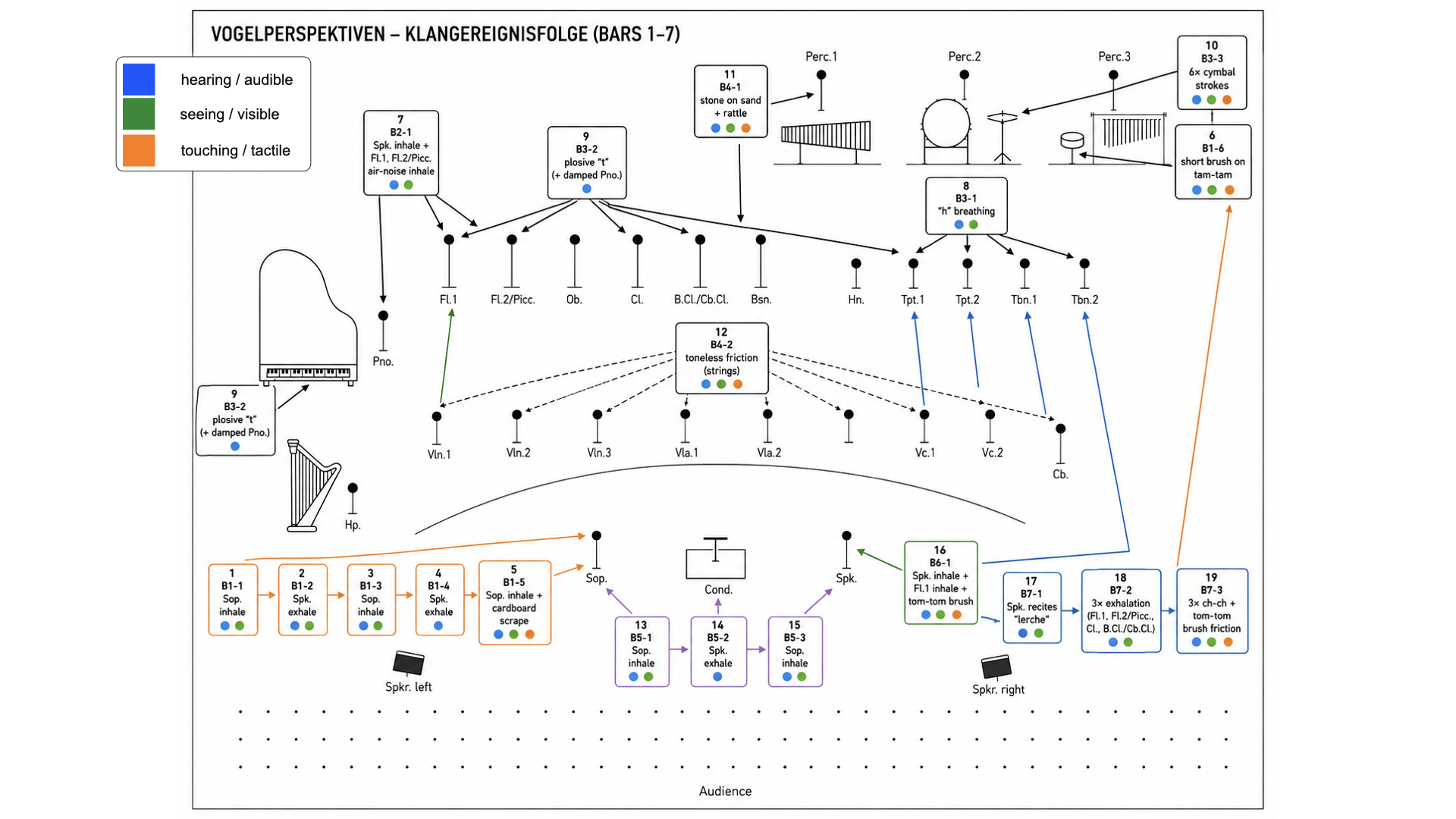
In Isabel Mundry’s Vogelperspektiven (2015), I examined relations between audible, visible, and tactile actions by mapping the opening eight bars onto the spatial arrangement of the performers (Pinkas 2026a). The soprano’s inhalations are answered by the speaker’s exhalations. On a further inhalation, a brush is drawn across cardboard, followed by a brief brush stroke on the tam-tam. The exchange of breath between two bodies can be heard continuing as friction against a surface. In the sixth movement, the relation between the two voices is taken up again through an exchange of bird whistles.
popisek
popisek
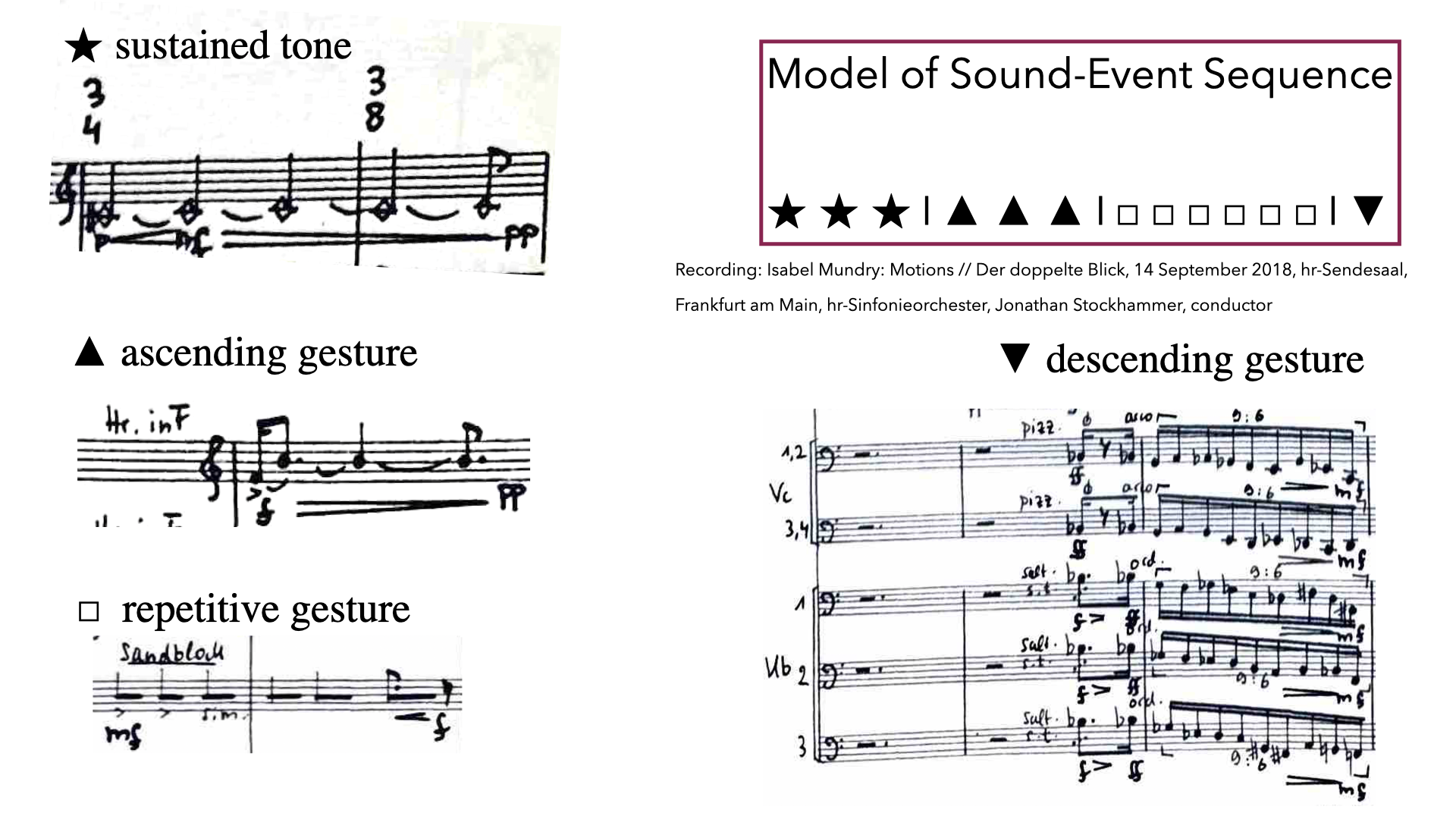
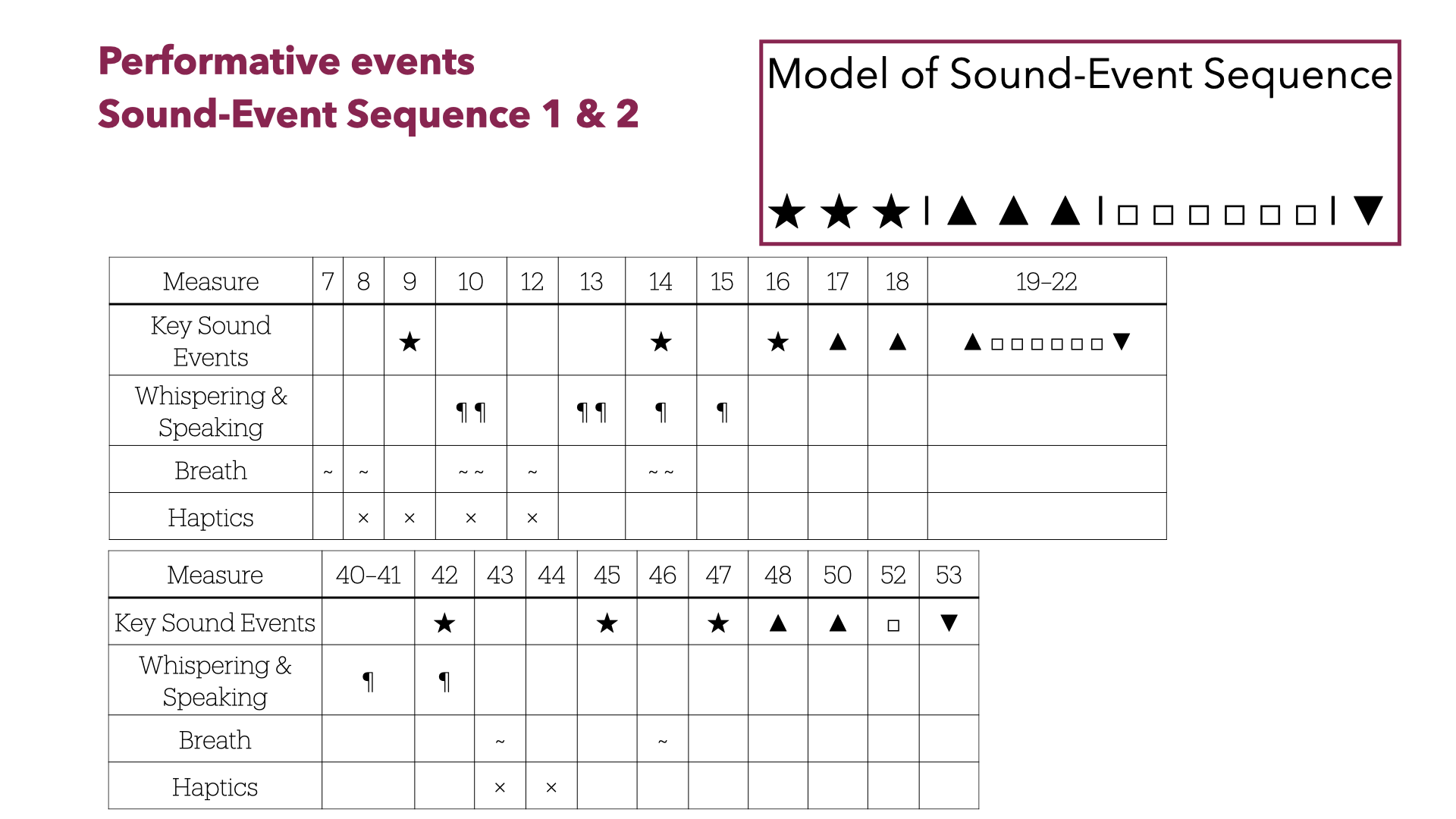
In Mundry’s Motions // Der doppelte Blick (2014/15), I identified six sequences of sound events in the second movement (Pinkas 2026b). A sustained tone, an ascending gesture, a repetitive gesture, and a closing descent were identified as recurrent elements. Across the sequences, instrumental gestures are gradually taken over by breath, noise, and whispering voices. What was initially heard as a secondary layer of voice, breath, and material contact can thus be heard assuming a formal function previously fulfilled by instrumental gestures.
popisek
popisek
popisek
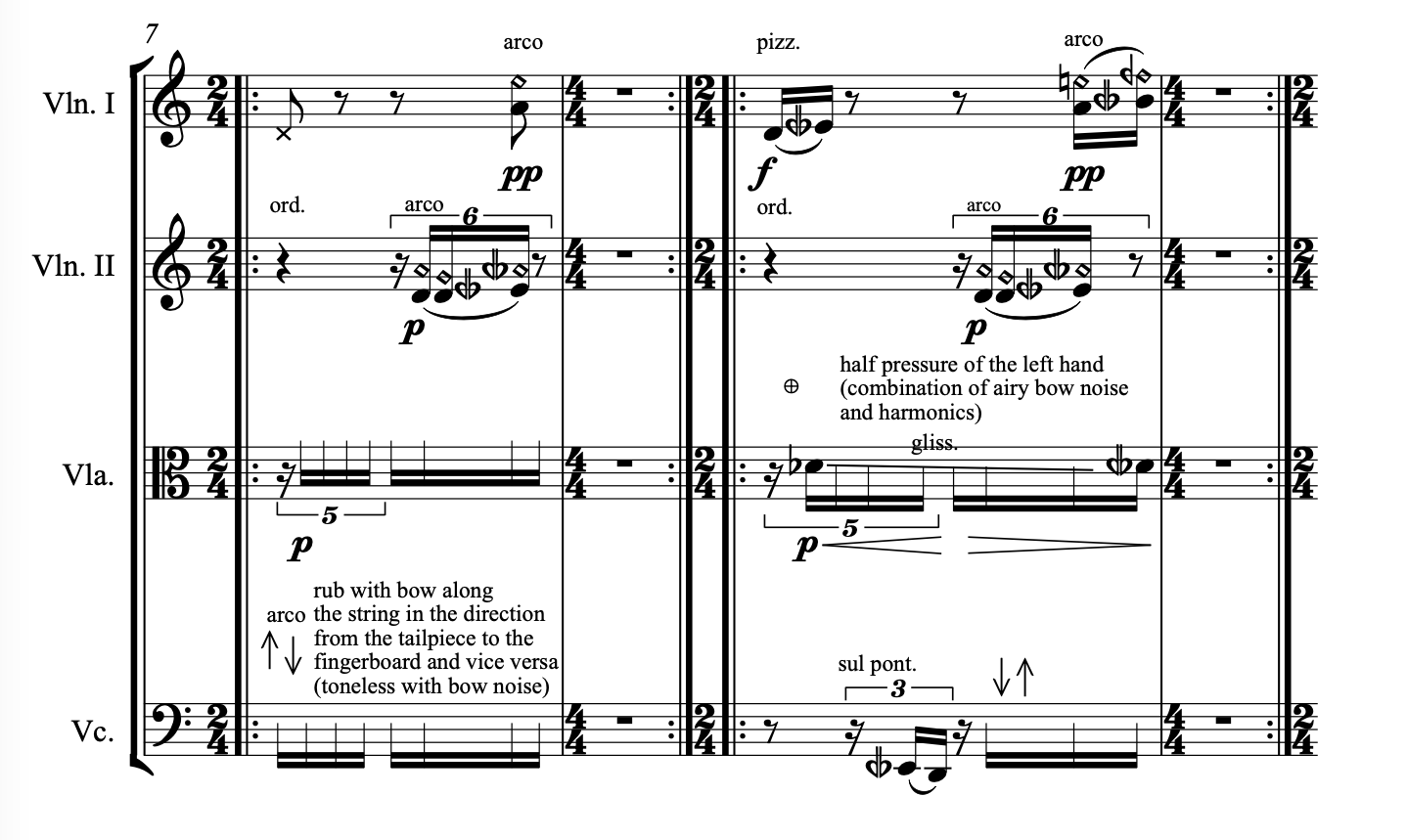
Figure 2. Michael Pinkas, String Quartet Virtues and Vices (2023). Two-second gestures briefly freeze in silence like sculptures. Although they sound almost indistinguishable, the performers’ movements at the end of each gesture differ.
popisek
popisek
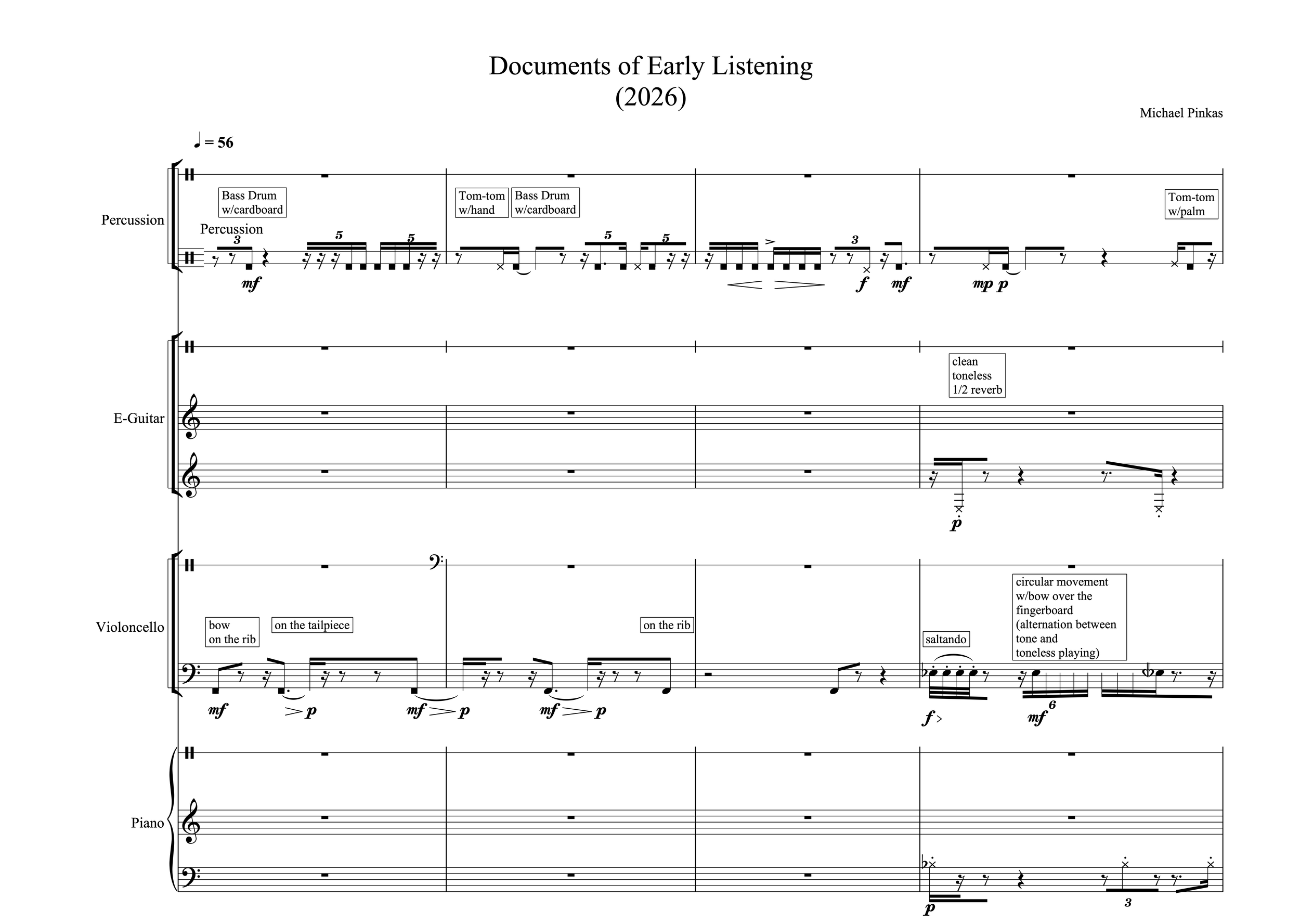
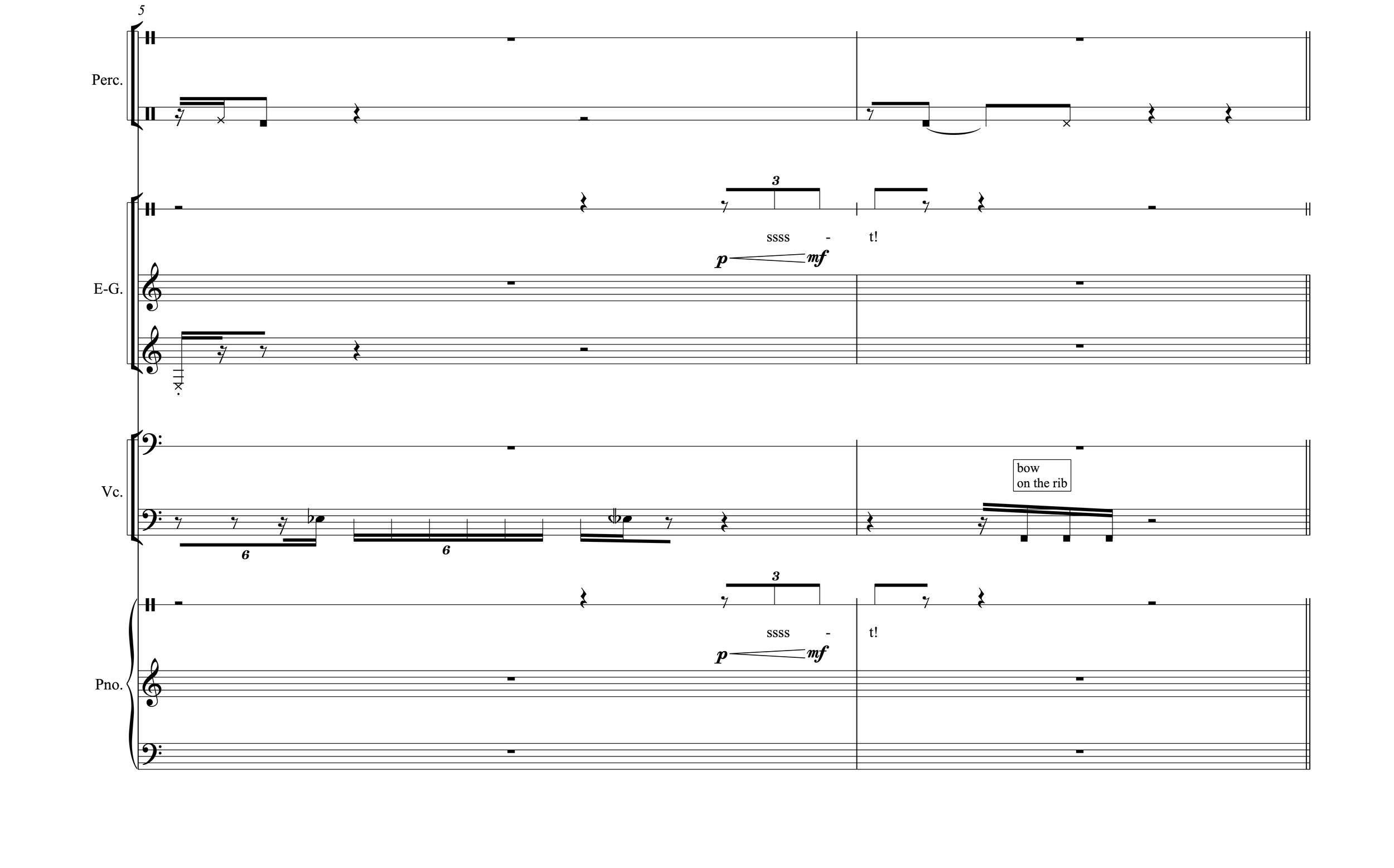
I also explored relations between hearing, seeing, and touching in my own compositional practice earlier in 2026, before the AR Pilot project began. Documents of Early Listening (2026), for piano, percussion, electric guitar, and cello, was developed during Isabel Mundry’s composition masterclass at the International Summer Academy of the mdw and premiered by PHACE on 1 August 2026 at the Klangtheater in Vienna. The experience of composing the quartet and hearing it in performance forms part of the preparation for the new work for clarinet, viola, and percussion.
popisek
popisek
While my doctoral research examines these relations in existing compositions through discourse, structural, and performative analysis, Lecture on Immanent Corporeality extends this inquiry into compositional and performance practice. The relations identified analytically become material for a new composition, to be examined through the experiences of performers and listeners.
4.Input: the practice-led preparatory phase
In the preparatory phase, passages from the post-war repertoire of Pierre Boulez, György Ligeti, Helmut Lachenmann, Heinz Holliger, Mauricio Kagel, and Dieter Schnebel are considered alongside more recent works by Isabel Mundry, Georg Friedrich Haas, Chaya Czernowin, and Carola Bauckholt. The constellations are distinguished according to the actions involved and what becomes perceptible through them. Attention is paid to listening and becoming audible, looking closely and becoming visible, touching and being touched.
A table of gesture terminology is being compiled from Mundry’s writings and from the literature on her music. Each expression is recorded in its original wording, together with the passage, source, page, and work where applicable. Early groupings include gestures associated with bodily performance, temporal and compositional processes, expressive meaning, intermedial relations, and listening. These categories remain provisional and may overlap. In “Das Objekt der Geste,” Mundry describes the gesture of listening as “a phenomenon between conceiving and responding, planning and yielding” (2022, 274).
Before the concert, the three performers will be invited, through interviews or questionnaires, to describe where they encounter these constellations in their own playing. Their responses will be considered alongside the repertoire analyses in preparing a systematic overview for the Research Catalogue.
In composing the new work for clarinet, viola, and percussion, I draw on both the performers’ responses and the repertoire analyses. The relations described analytically can thus be explored through compositional practice, in what Darla Crispin calls the “dual situatedness of the artist-researcher” (2015).
5.Process: the forty-five-minute performance-lecture
During the concert and lecture, the composition will be performed by the trio while the constellations assembled in the Research Catalogue are projected onto a screen behind the players. What can be heard in an action, what can be seen of it, and what can be felt only by the person playing are given different weight in the course of the composition.
The lecture presents an analysis and allows listeners to follow the relations it describes as they unfold in performance.
The combination of trio and screen makes it possible to examine discrepancies between the audible and visible aspects of a gesture in the act of performance. The reach and the limits of analytical description can thus be tested through the very actions it seeks to describe.
Listeners will be invited to participate in a discussion and to describe their experiences in a voluntary questionnaire.
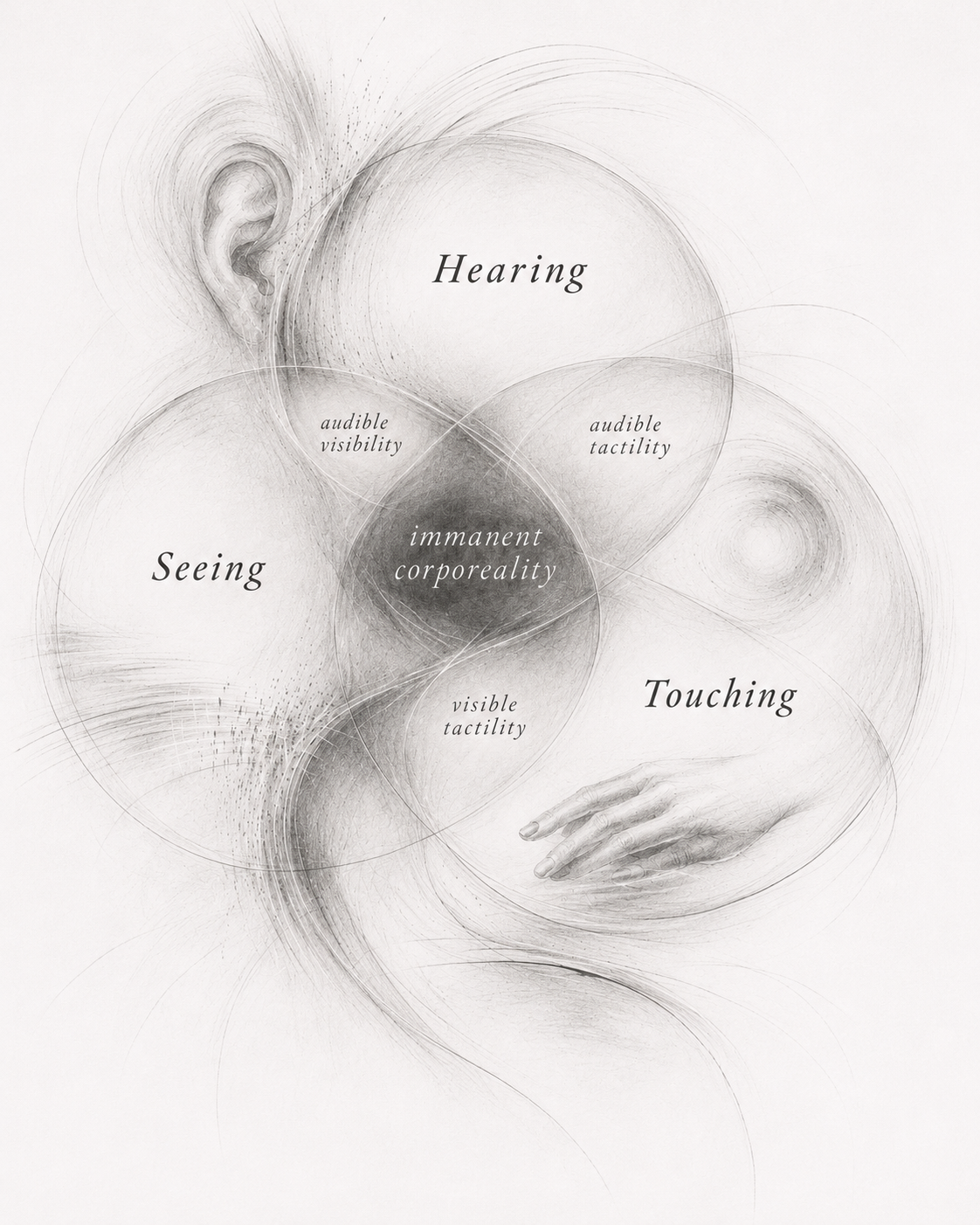
Figure 8. Conceptual sketch of hearing, seeing, and touching in musical performance. Hearing refers to audible events such as instrumental sounds, breath, friction, and resonance; seeing to the performers’ visible movements and gestures; and touching to bodily contact with instruments, including tactile resistance and vibration experienced by the performers. Their interrelations are represented as audible visibility, audible tactility, and visible tactility. Immanent corporeality emerges through the convergence, transformation, and discrepancies between these three modes of perception.
6. Output: post-performance reflection
After the concert, the performers’ reflections will be compared with their preliminary descriptions of the constellations encountered in playing. To bring these perspectives of “cognitive subjectivity” (Crispin 2015) into relation, selected passages will be revisited through the compositional material, the video recording, and reflections from the performers and the audience. These materials will also enable the project “to interrogate itself” (Cook 2015, 30) by critically examining its own compositional and analytical assumptions in relation to the experiences of performers and listeners.
The analysis will retain differences between a gesture conceived in composition, felt in playing, and perceived in listening, including where descriptions from the three perspectives remain divergent.
For the project presentation at SAR 2027, selected passages from the pilot will be presented through the score, excerpts from the concert recording, and the performers’ and listeners’ reflections in the Research Catalogue.

Manuscripts of my compositions Dance for Two Violins (2020) and Capriccio (2021) in which I explored the phenomenon of gesture for the first time.
Selected references
Cook, Nicholas. 2015. “Performing Research: Some Institutional Perspectives.” In Artistic Practice as Research in Music: Theory, Criticism, Practice, edited by Mine Doğantan-Dack, 11–32. Ashgate.
Crispin, Darla. 2015. “Artistic Research and Music Scholarship: Musings and Models from a Continental European Perspective.” In Artistic Practice as Research in Music, edited by Mine Doğantan-Dack, 53–72. Ashgate.
Drees, Stefan. 2011. Körper Medien Musik. Körperdiskurse in der Musik nach 1950. Wolke.
Hatten, Robert S. 2004. Interpreting Musical Gestures, Topics, and Tropes: Mozart, Beethoven, Schubert. Indiana University Press.
Heinzelmann, Sigrun, and Sihua Ren. 2023. “Embodied Music Analysis: Musikanalyse als ‘Embodied Practice’.” 23rd Annual Congress of the Gesellschaft für Musiktheorie, Freiburg.
Internationale Sommerakademie der mdw. 2026. “Just Composed.” Concert programme, Klangtheater, Vienna, 1 August.
Linke, Cosima. 2025. “Posthermeneutik und Analyse neuer Musik: Klangsinnliche und körperlich-performative Aspekte in der Musik Helmut Lachenmanns und Isabel Mundrys.” In SINNE | SINN, edited by Kathrin Kirsch and Joe Reinke, 83–108. Olms.
Livingston, Guy. 2025. Performing Musical Silence: Markers, Gestures, and Embodiments. Research Catalogue. https://doi.org/10.22501/acpa.1712958.
Lüneburg, Barbara. 2026. “Embodying Expression in Classical Instrumental Performance Practice: A Musical-Gestural Perspective.” In Music and Motion: Interweaving Artistic Practice and Theory in Dance and Beyond, edited by Stephanie Schroedter, 459–481. transcript. https://doi.org/10.14361/9783839400258-025.
Mersch, Dieter. 2010. Posthermeneutik. Akademie Verlag.
Mundry, Isabel. 2020. Composer’s note on Noli me tangere, for solo percussion and ensemble. Breitkopf & Härtel.
Mundry, Isabel. 2022. “Das Objekt der Geste.” In Musik und Subjektivität, edited by Daniel Martin Feige and Gesa zur Nieden, 265–277. transcript.
Pinkas, Michael. 2022. “Tempting of Speech in Music Education: Reflections on Thomas Mann’s Doktor Faustus.” Theology and Philosophy of Education 1 (2): 25–32. https://doi.org/10.5281/zenodo.7432133.
Pinkas, Michael. 2023. “Der Schaffensprozess des musikalischen Analysierens und Komponierens anhand hörbiographischer und autoethnographischer Methoden – dargestellt am Beispiel Isabel Mundrys Noli me tangere.” 23rd Annual Congress of the Gesellschaft für Musiktheorie, Freiburg, 23 September.
Pinkas, Michael. 2026a. “Birds as Latent Microphones: Corporeality and Acoustic Territories in Isabel Mundry’s Vogelperspektiven.” Dublin Music Analysis Conference.
Pinkas, Michael. 2026b. “Performative Perception of Form in an Imaginary Choreography: Motions // Der doppelte Blick by Isabel Mundry.” EuroMAC 11, Barcelona.
Pinkas, Michael. In preparation. “Offener Leerraum. Auditive und performative Formwahrnehmung von Gesten am Beispiel der Komposition Noli me tangere von Isabel Mundry.” Manuscript for GMTH Proceedings, 23rd Annual Congress of the Gesellschaft für Musiktheorie, Freiburg 2023.
Rebstock, Matthias. 2011. “Strategien zur Produktion von Präsenz.” In Das Konzert: Neue Aufführungskonzepte für eine klassische Form, 2nd expanded ed., edited by Martin Tröndle, 143–152. transcript.
Schroedter, Stephanie. 2017. “Musik erleben und verstehen durch Bewegung. Zur Körperlichkeit des Klanglichen in Choreographie und Performance.” In Musik und Körper, edited by Lars Oberhaus and Christoph Stange, 221–244. transcript.
Zenck, Martin. 2014. “Vom Berühren der Klaviertasten und vom Berührtwerden von Musik.” In Verkörperungen der Musik, edited by Jörn Peter Hiekel and Wolfgang Lessing, 117–136. transcript.